
A Letter to Wisconsin Catholics on Faithful Citizenship

Published October 8, 2026
optimizing

A Letter to Wisconsin Catholics on Faithful Citizenship


Dear Brothers and Sisters in Christ,
Every two years, ahead of the elections, we invite you to consider what it means to be a citizen who is faithful to Christ. This year, moved by the election of the first American pope, we wish to highlight Pope Leo XIV’s Address to Members of the Diplomatic Corps Accredited to the Holy See (January 9, 2026). Inspired by St. Augustine’s City of God, Pope Leo’s address brings to the fore global issues that are especially relevant to our social and political landscape in the United States.
Protect human life. Pope Leo “considers it deplorable that public resources are allocated to suppress life, rather than being invested to support mothers and families. The primary objective must remain the protection of every unborn child and the effective and concrete support of every woman so that she is able to welcome life.” He adds, “we firmly reiterate that the protection of the right to life constitutes the indispensable foundation of every other human right. A society is healthy and truly progresses only when it safeguards the sanctity of human life and works actively to promote it.”
Protect religious freedom and human rights. Pope Leo writes that religious freedom is “the first of all human rights, because it expresses the most fundamental reality of man.” And yet in many places, “religious freedom is considered … more as a ‘privilege’ or concession than a fundamental human right.” Christians sometimes face restriction or discrimination when they proclaim the truths of the Gospel and “defend the dignity of the weakest, the unborn, refugees and migrants, or promote the family.” We must protect against the dilution of human rights which “occurs when each right becomes self-referential, and especially when it becomes disconnected from reality, nature, and truth.”
Promote the family. Pope Leo explains that “the institution of the family faces two crucial challenges today. On the one hand, there is a worrying tendency in the international system to neglect and underestimate its fundamental social role, leading to its progressive institutional marginalization. On the other hand, we cannot ignore the growing and painful reality of fragile, broken and suffering families, afflicted by internal difficulties and disturbing phenomena, including domestic violence.”
Uphold human dignity of all, including migrants and prisoners. Pope Leo notes that “every migrant is a person and, as such, has inalienable rights that must be respected in every situation.” He hopes that “the actions taken by States against criminality and human trafficking will not become a pretext for undermining the dignity of migrants and refugees.” He adds that “the same considerations apply to prisoners, who can never be reduced to the crimes they have committed. We cannot reduce individuals to objects. We must “stand in defense of the inalienable dignity of every person.”
Promote political dialogue and build consensus. Summarizing St. Augustine, Pope Leo warns “of the grave dangers to political life arising from false representations of history, excessive nationalism and the distortion of the ideal of the political leader.” We must have “a diplomacy that promotes dialogue and seeks consensus among all parties” and not replace it with “diplomacy based on force.” This type of distortion “gravely threatens the rule of law, which is the
foundation of all peaceful civil coexistence.”
To learn more about Catholic Social Teaching, please read the reverse of this letter. Read the fuller explication found in Forming Consciences for Faithful Citizenship: A Call to Political Responsibility from the Catholic Bishops of the United States (faithfulcitizenship.org). Sign up for the Wisconsin Catholic Conference’s advocacy network at
wisconsincatholic.org/advocacy-network.
Above all, pray, form your conscience, vote, and remain engaged in civic life. Inspired by St. Augustine and Pope Leo, may we all turn our hearts to the heavenly city, our true home, as we seek to foster true peace here on earth.
Sincerely yours in Christ,
Most Reverend David L. Ricken
Bishop of Green Bay
Most Reverend Gerard W. Battersby
Bishop of La Crosse
Most Reverend Jeffrey S. Grob
Archbishop of Milwaukee
Most Reverend Donald J. Hying
Bishop of Madison
Most Reverend James P. Powers
Bishop of Superior 
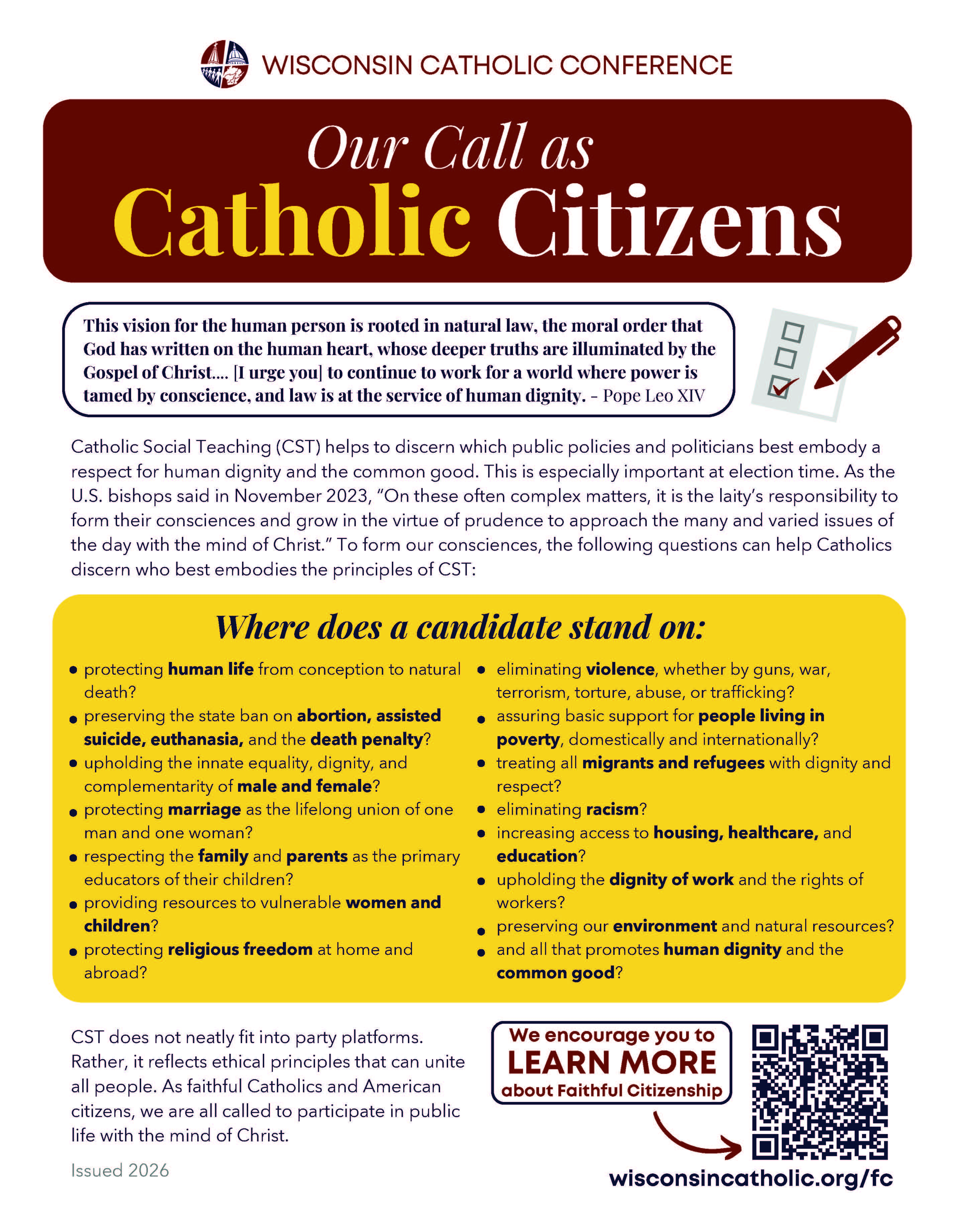
The Wisconsin Catholic Conference has resources at wisconsincatholic.org/fc that are based on the U.S. bishops' statement, Forming Consciences for Faithful Citizenship: A Call to Political Responsibility from the Catholic Bishops of the United States (faithfulcitizenship.org).
Faithful Citizenship is the mindful consideration of public policy and voting issues through the lens of the Church’s teaching.